





The complete guide
How To Choose And Set Up A Desktop Cigar Humidor
The problem a humidor solves
Cigars arrive at your door in a state someone worked hard to achieve. The tobacco has been fermented, aged, rolled and rested at a particular moisture level, and the moment it leaves that environment it starts to change. A cigar sitting on a bookshelf in a dry room can go brittle in a week. The wrapper cracks when you cut it, the burn runs up one side, and the flavour you paid for turns sharp and papery.
The other direction is just as bad. A cigar left somewhere damp takes on more water than it should. It draws hard, it goes out halfway, and what should be a relaxed hour becomes a wrestling match with a lighter.
A desktop humidor fixes both by giving the cigars their own small climate. Sealed box, cedar lining, a source of moisture and a way to read what is happening inside. That is the whole idea. Everything else is detail.
How a cedar humidor actually works
There are three parts doing the work.
The box itself provides the seal. Lid down, the air inside is mostly separate from the air in your room. It is never perfect, and it does not need to be. It just needs to be slow.
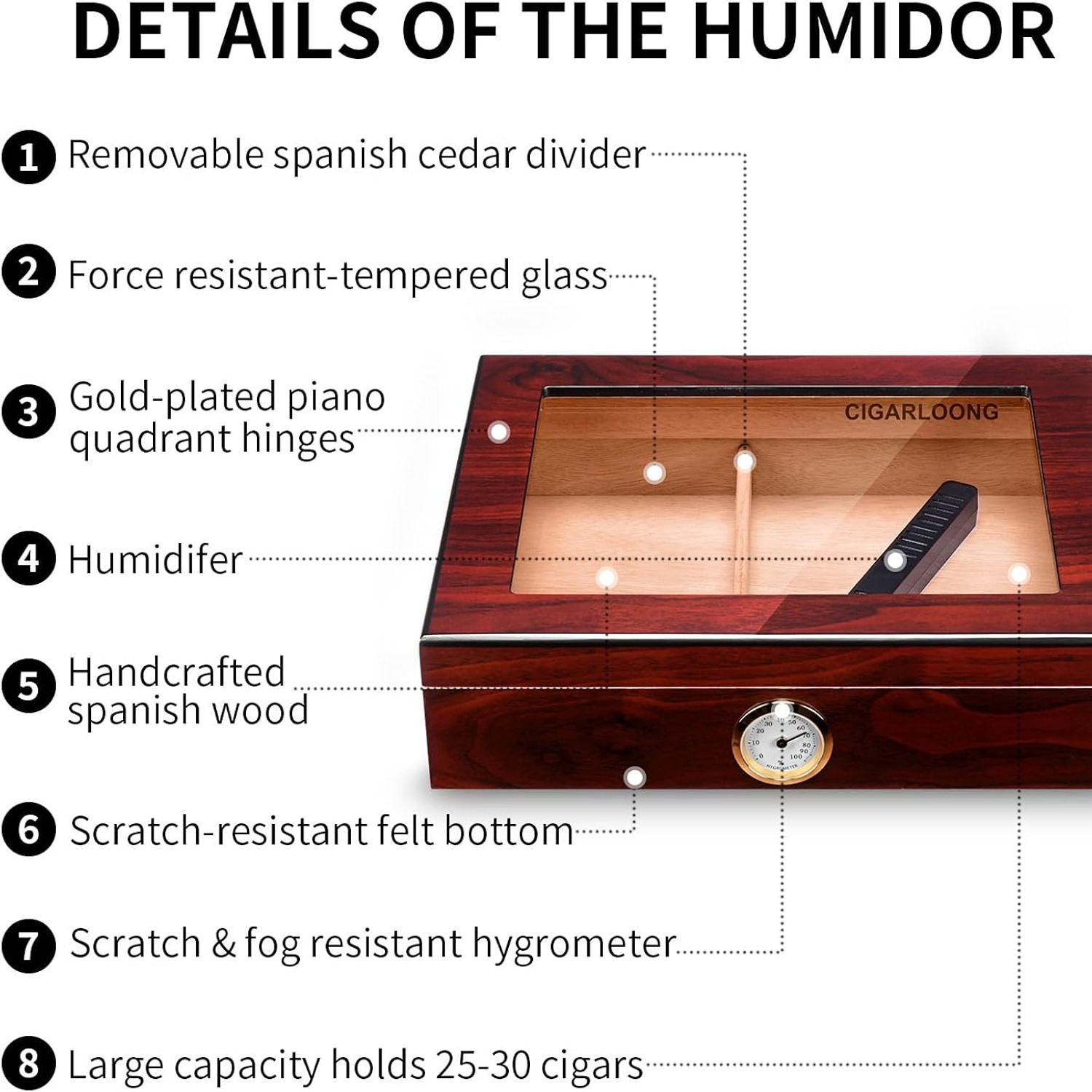
The Spanish cedar lining is the buffer. Cedar is unusual in how it takes on moisture and lets it go again, steadily rather than suddenly. When you open the lid and let dry room air in, the cedar gives some moisture back and softens the drop. When the humidifier runs a little strong, the cedar soaks up the excess. Over time it acts as a shock absorber for humidity. It also carries that familiar cedar smell, which many smokers consider part of what long rest does to a cigar.
The humidifier and hygrometer are the control pair. The humidifier supplies moisture. The hygrometer tells you whether that is working. One without the other is guesswork, which is why having both included matters more than people expect when they are buying their first box.
This humidor adds a fourth piece, a glass window in the lid. It sounds cosmetic and it partly is, but it also saves openings. If you can see your row of cigars through the glass, you do not lift the lid just to check what is left. Fewer openings means fewer humidity swings.
Who it suits
Someone buying their first proper storage. You get the lining, the humidifier and the hygrometer together, so you are not standing in a shop trying to work out which gauge to buy separately. For a lot of people looking for the best desktop humidor to start with, that bundling is the deciding factor.
Someone with a small working collection. At 25.91 by 22.1 by 6.86 cm this is a desk and shelf humidor, not a cabinet. If you keep a handful of sticks on rotation and buy a few more every month, that scale fits. If you are storing a hundred cigars for a decade, you want something larger.
Someone buying a gift. A glass-top cedar box photographs well, unwraps well, and can be used the same week. Add a few cigars the recipient already enjoys, because cigars are not included.
Someone who wants to see the collection. The window is genuinely nice to live with. It turns storage into something you glance at rather than something you forget in a cupboard.
How to choose the right size
Count what you keep, not what you hope to keep. Most people overbuy on the first humidor, then find the box half empty, which actually makes humidity harder to hold steady because there is more air and less tobacco to buffer it.
Then think about shape. Ring gauge changes everything. A box that comfortably holds twenty slim cigars might take ten fat ones laid in a single layer. That is why a fixed capacity number means little without knowing the stick. Work from the internal footprint and the cigars you actually smoke.
Leave a little room for the divider. If you keep two or three different blends, splitting them stops the stronger ones pushing aroma into the milder ones over months. The divider here lifts out when you want one long bay instead.
Finally, think about where it will live. Away from windows, radiators and air conditioning outlets. A spot with a steady room temperature does half the work for you.
Seasoning, the step people skip
A new humidor arrives dry. The cedar has not been conditioned, and if you load cigars in straight away the wood will pull moisture out of them for days. People then blame the humidor for drying their cigars when the humidor was only doing what dry wood does.
Season it first. Charge the humidifier, close the lid, and let the box sit for several days while the cedar takes up moisture. Watch the hygrometer. When the reading climbs and then holds steady in your target band, the box is ready. Only then do the cigars go in.
Use distilled water or a solution made for humidors. Tap water carries minerals that block humidifier media and can encourage mould inside a sealed cedar box. Do not pour or wipe water directly onto the lining, which can warp it.
Living with it day to day
Once seasoned, a humidor is low effort. Check the hygrometer every few days at first so you learn how your room behaves. Most people settle on a target somewhere between 65 and 75 percent, with drier rooms and higher-gauge cigars nudging that choice either way.
Refill the humidifier when the reading starts drifting down. There is no calendar for it. A sealed box in a stable room might go weeks, the same box next to a heater might need attention much sooner.
Open the lid less than you think you need to. That is where the glass top earns its place. Pick your cigar by eye, open once, take it out, close it.
For cleaning, keep it simple. A soft dry cloth on the polished exterior. Nothing wet, no household spray, no furniture polish. Inside, dust or a stray flake of tobacco can be brushed out, but leave the cedar alone otherwise. It does not want oils or cleaners, and anything you put on it will end up in your cigars.
The flannel base takes the wear against your desk, so there is nothing to do there beyond lifting the box rather than dragging it.
Small things worth knowing
The hinges are stainless steel and hold the lid at roughly 90 degrees, which matters more than it sounds. A lid that flops shut while you are reaching in is a daily annoyance, and a lid that will not close flat on the seal leaks humidity.
Hygrometers in any humidor are worth sanity checking now and then, since a reading you cannot trust is worse than no reading at all. If your figure looks implausible for your climate, test it before you start adjusting the humidifier.
Capacity will always be approximate. Judge by your own cigars.
The short version
A desktop humidor keeps cigars in the condition they were made in, and that is the whole point. This one gives you a Spanish cedar lining to buffer humidity, a glass top so you can look without opening, a humidifier and hygrometer so you can control and check conditions from day one, and a removable divider to keep blends apart.
Season it before you use it. Use distilled water. Keep it away from heat and sun. Read the hygrometer until you know your room, then relax and let the cedar do its job.
Do that, and the cigars you buy will taste the way they were meant to, whether you smoke them next week or next year.